
 Leela J Williams
Computers are selecting our cards! Whole sites are now dedicated to Tarot interpretation. I know this because the companies that created them have used AI to find my email address. No doubt they have sent the same communication to hundreds, if not thousands, of publications globally. Would our readers be interested in an AI-written article that promotes their AI-driven service? I don’t bother replying because no one is behind the interaction—there is no genuine connection to be made. And without connection, what is the point?
My inbox activity got me thinking about the relationship between Tarot and technology. It’s a conundrum that reminded me of my dear friend, Simon Turnbull, the co-founder and long-time President of the Australian Psychics Association. Simon was intrigued by Tarot from the 1970s and had an enviable collection of decks and books. He was excited by the 78-card system, noting that the odds of getting the same reading twice were astronomically low. He also felt the randomness of shuffling and choosing cards created a possibility for other sources of intelligence to communicate through the Tarot.
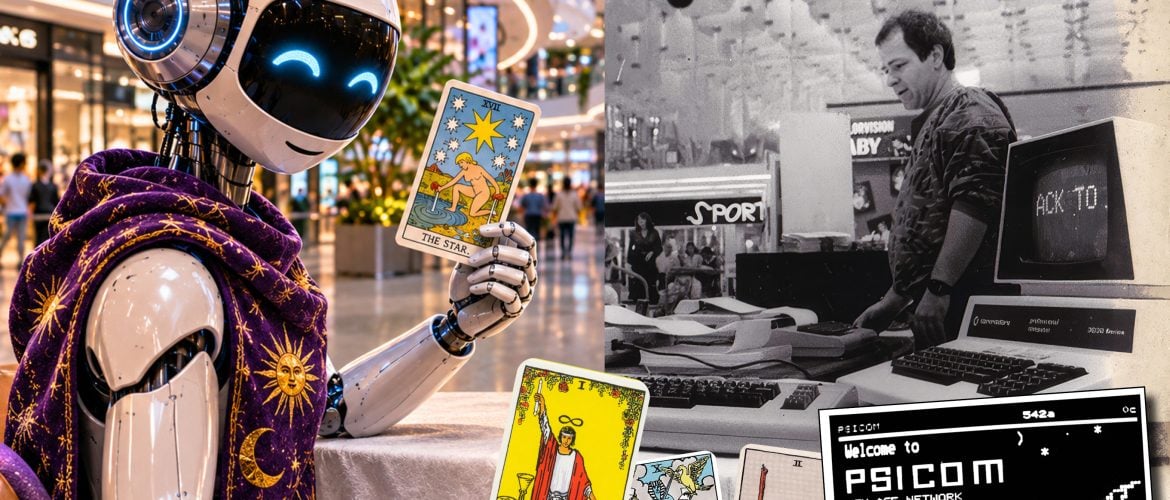
When the first desktop computers became available, he saw the possibility for a program that could speed up the Tarot-reading process and make its wisdom more accessible. In 1983, with the aid of a computer engineer, he managed to put all the information into a Commodore 64. There wasn’t enough memory for any graphics.
As technology advanced, Simon expanded the program with details that gave the computer-generated readings greater accuracy and specificity. He incorporated randomness into the programming because he believed it was a key element. Here’s how he explained it:
“Spirits operate on a much faster frequency than the human mind. Thus, spirits lower or slow their vibration and mediums heighten or speed their vibration until they meet somewhere in the ether. Only when both parties are communicating at a similar vibration can a dependable amount of information be exchanged. I surmised that the random process had to be pure. The data in the program had to be accessed in such a way that a source operating at a faster rate than the computer could punch the right information into the right order. Universal intelligence could then communicate via randomness, in a way that made the reading accurate.”
Simon passed away in 2014. However accurate his computer-generated readings were, they could never replace a reading or a conversation with him. I do wonder what Simon would think of the AI-driven Tarot-reading industry — I will not be surprised if he finds a way to let me know. Who knows, he may even surprise me by communicating via AI! But … that would be very surprising.*
The Tarot Guild of Australia released their AI policy in July 2026. While the policy says they support innovation, it also makes it clear that Tarot is a human-centred practice. The unacceptable uses include providing “professional Tarot readings without clear disclosure.” I guess I can’t see the value in paying for an AI-generated reading that I could (if I was so inclined) generate myself. But the point is the disclosure. As we navigate our own comfort around AI, it’s important to know where the human reading ends and the computer generation begins. How much of a Tarot reading can we hand over to AI before it becomes something else?
I was always excited by Simon’s excitement for technology. His original computer program couldn’t even show pictures of the cards. Yet he thought it could be a conduit for Spirit to work through. We now have machines that can produce elaborate personalised Tarot readings in seconds. But like those emails that keep arriving, they are not personal. Without a human element, we are left to ask what we are connecting to, what we are believing and what we are trusting. Technology advances, but the questions remain: Does divination need a human element? How much of our practice are we willing to give away?
*Between submitting this article and publication, I did receive a message from Simon. The messenger was his widow, Hiromi. In a dream, Simon encouraged me to continue publishing his works. The message wasn’t about AI, nor through AI. Shall I take that as his vote for human connection? I think, yes.
Image shows Simon Turnbull demonstrating Tarot software on Commodore computers in 1986.
Connect with Leela at https://linktr.ee/leelajwilliams and find her oracles and journals, including Maxine Gadd’s Zoologica: The Steampunk Oracle at Tarotopia

 Kim Lorraine Russell

 Charlie Lally




Add comment