

 Thomas Staudacher
How Biological Sound and Vibration Shape Our Wellbeing
For centuries, philosophers and scientists have described the human body as an instrument — a living system constantly responding to rhythms, patterns, and vibrations. While this idea once belonged mainly to poetry and philosophy, modern science is beginning to reveal something remarkable: the body is far from silent. In fact, every part of us vibrates.
From the microscopic movements inside a single cell to the rhythmic patterns of the heart and brain, the human body operates through continuous oscillation. These subtle motions create what some researchers describe as the body’s intrinsic soundscape — a complex orchestra of biological signals that guide communication throughout our tissues.
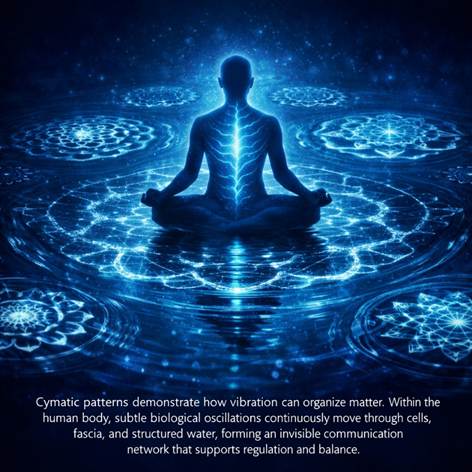
Every cell in the body moves and responds to mechanical forces. Structures inside the cell constantly shift, membranes oscillate, and proteins change shape as they carry information. Even the scaffolding that gives cells their structure — the cytoskeleton — behaves like a responsive network, capable of transmitting signals through vibration and tension.
But these signals do not remain confined to individual cells. They travel through a vast communication network that connects the body from head to toe.
One of the most fascinating parts of this system is the fascia, the connective tissue that surrounds muscles, organs and nerves. Once thought to be little more than packing material, fascia is now recognised as an important communication network within the body. Because it is highly sensitive to mechanical movement, fascia can transmit subtle vibrations across large areas, helping different parts of the body remain coordinated.
Water also plays a central role in this process. The human body is composed of around sixty percent water, and much of this water exists in structured forms within cells and connective tissues. Researchers have discovered that this structured water can respond to vibrational patterns, acting as a medium through which biological signals travel.
Together, these elements create a dynamic communication system where information flows not only through chemical signals but also through mechanical movement and subtle vibration.
This perspective is helping scientists understand the body in a new way. Instead of viewing biology purely as a chemical process, it is increasingly seen as a system of organised patterns and interactions — a living network responding continuously to its environment.
The environments we live in, therefore, play a much larger role in our well-being than we often realise. Modern life exposes us to constant stimulation: noise, screens, stress and fragmented attention. These influences can overwhelm the body’s natural rhythms, which it relies on to maintain balance.
When the environment becomes chaotic, the body’s internal signals can become equally disorganised.
Creating environments that support coherent biological signalling may therefore be one of the most important steps in restoring a sense of calm and regulation.
This understanding has inspired new approaches within the field of biofield wellness. One such approach is ENTLE®, a signalling-informed relaxation environment designed to support the body’s natural regulatory processes. Through its Hydrosonic and Biosonic Resonance Activation, ENTLE® works with gentle acoustic patterns and the conductive properties of water to create conditions that encourage deep relaxation.
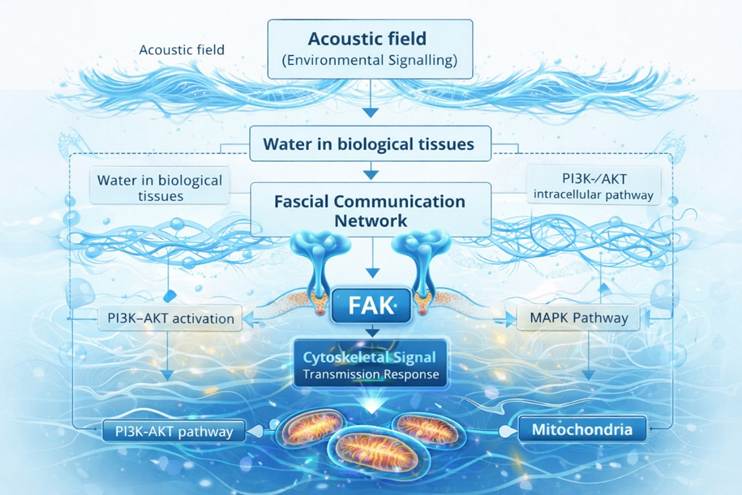
Figure:
A simplified model showing how environmental acoustic signals may travel through water-rich tissues, fascia, and cellular mechanotransduction pathways, influencing intracellular signalling and mitochondrial activity.
Rather than attempting to force change within the body, the intention is simply to provide an environment where the body’s own communication networks can settle and reorganise.
In many ways, this perspective brings us back to an ancient idea: that the human being is not merely a machine of chemical reactions, but a living system of rhythm, pattern and resonance.
When the environment supports these natural patterns, the body often responds in remarkable ways.
Perhaps the greatest lesson emerging from this research is simple yet profound: our bodies are constantly listening.
And sometimes, the most powerful shift begins when we create the space for that quiet internal music to be heard again.
Experiencing ENTLE®
ENTLE® sessions take place in calm, purpose-designed environments that support listening, settling, and internal coherence. Each session offers space for the body to recognise its own rhythms — without instruction or demand.
Sessions are available by appointment at selected locations, including Brisbane and the Sunshine Coast, with a new centre opening within Maroochy Private Hospital.
To learn more or enquire about availability, visit: www.entle.com.au
Follow ENTLE® for reflections and updates:
Instagram: https://www.instagram.com/entle_hq/
Facebook:https://www.facebook.com/p/Entle-100077714649314/
 Kristy Burnett
 Chris and Shveta





Add comment